
Music Is Directive: Rethinking Non-Directive Psychedelic Practice
Music is never a neutral backdrop in psychedelic therapy. Even the quietest drone or softest harmony can shape the body’s sense of movement, safety, and emotional direction. For neurodivergent listeners, who often perceive sound in sharper detail, those shifts can feel like guidance or intrusion. This article explores why music acts as a directive force in psychedelic sessions, how that influence intersects with autonomy and consent, and what facilitators can do to create soundscapes that support rather than steer the inner journey.

Scoring the Journey Part Five: Quick Modality Notes — Soundscapes Across Medicines
Different medicines create different relationships with sound. Each alters time, emotion, and body awareness in its own way. This guide outlines how music interacts with psilocybin, LSD, MDMA, ketamine, and DMT—offering practical notes for facilitators working with neurodivergent clients. Drawing from research by Mendel Kaelen and others, it explores how tone, tempo, and texture can guide regulation, deepen surrender, and harmonize with each medicine’s rhythm.

Journey Music for Psychedelic Playlists: Helios — Veriditas (2018)
Helio’s Veriditas invites the listener into dreamlike, emotional terrain—music that feels both intimate and expansive. Its textures cradle the nervous system, supporting integration and reflection after the peak of a journey. This series explores albums that function as companions for inner work—soundtracks that hold, mirror, and move with the listener through altered states.
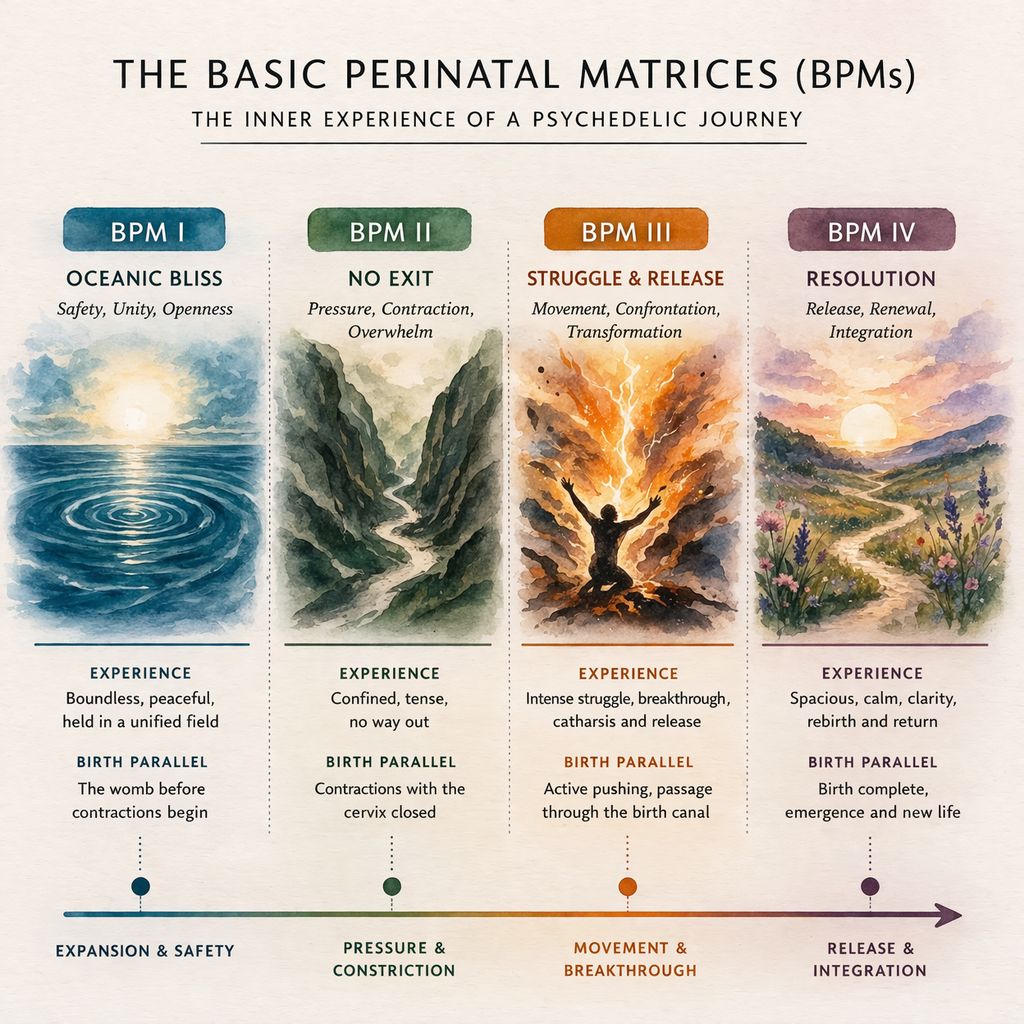
Contours of Sound: Mapping Stanislav Grof’s Basic Perinatal Matrices (BPMs) to Journey Phases and Music Choices
A track comes in low and slow, almost tidal, and the body begins to reorganize around it. Breath lengthens. The edges of the room soften. Over time, patterns start to repeat across journeys, described through maps like Grof’s Basic Perinatal Matrices (BPMs) and the Copenhagen Music Program (CMP). Each traces an arc of opening, pressure, movement, and return from a slightly different angle. When music is placed with care, it can move alongside that unfolding, steadying the nervous system, holding tension, and carrying energy as something inside begins to shift.