Scoring the Journey Part One: Building Playlists for Neurodivergent Psychedelic Healing
Music in psychedelic therapy does more than fill silence—it shapes how emotions, memories, and meanings move through the session. For neurodivergent participants, sound can be an anchor or an overwhelm, a safety or an intensity. This first part of Scoring the Journey lays the groundwork for playlist design that listens to the nervous system as much as the music itself.
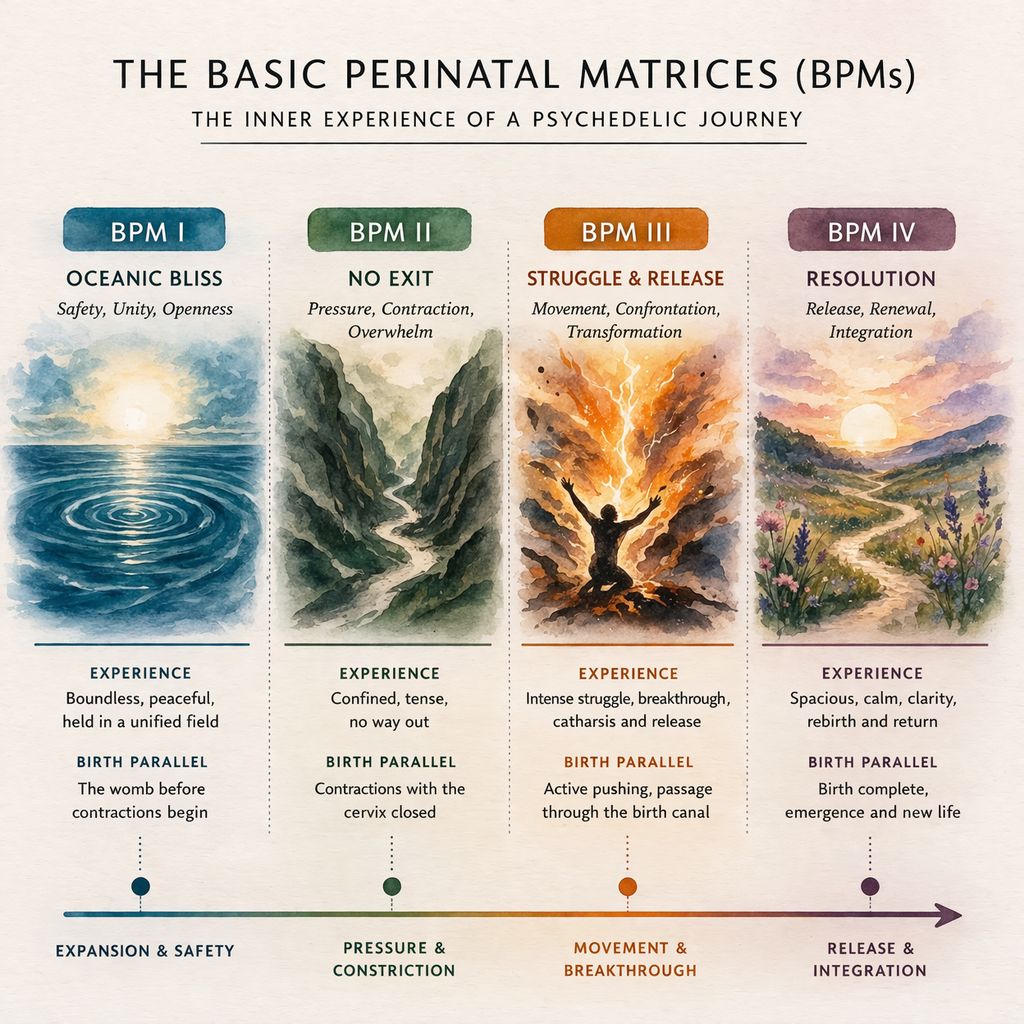
Contours of Sound: Mapping Stanislav Grof’s Basic Perinatal Matrices (BPMs) to Journey Phases and Music Choices
A track comes in low and slow, almost tidal, and the body begins to reorganize around it. Breath lengthens. The edges of the room soften. Over time, patterns start to repeat across journeys, described through maps like Grof’s Basic Perinatal Matrices (BPMs) and the Copenhagen Music Program (CMP). Each traces an arc of opening, pressure, movement, and return from a slightly different angle. When music is placed with care, it can move alongside that unfolding, steadying the nervous system, holding tension, and carrying energy as something inside begins to shift.
When Music Sits in the Chair: The Hidden Therapist Guiding Psychedelic Healing
In psychedelic therapy, music often acts like a co-therapist—guiding the journey, stirring emotion, holding presence, and helping people return. This article explores how sound becomes a partner in healing, tracing the lineage from early psychedelic research to today’s adaptive soundscapes, with special attention to trauma-informed and neurodivergent care.